Tackling Drug Resistance With Translational Models
Cancer drug resistance remains a central barrier in oncology development. At Crown Bioscience, we provide clinically relevant in vitro and in vivo resistance models and biomarker platforms to help you dissect resistance mechanisms and design next-generation countermeasures.
Why Cancer Drug Resistance Matters
Resistance to oncology therapeutics—whether targeted therapy, immunotherapy, or chemotherapy—limits durable responses in patients. Understanding how tumors evolve under treatment pressure is critical to designing better next-line therapies and predictive biomarkers.
Crown Bioscience integrates resistance modeling across cell lines, PDXs, and patient-derived tools, coupled with biomarker and multiomics platforms, to help you anticipate, test, and overcome resistance before clinical failure.
Explore Multiple Solutions for Model Development
Our unique four-step approach offers personalized strategies to address various drug resistance challenges, facilitating the successful acceleration of your project. By analyzing intrinsic and acquired resistance across diverse therapeutic types and molecular targets, we craft tailored solutions that enhance treatment efficacy.

Developing New and Clinically Relevant Models
Navigate the complexities of drug resistance using our strategic solutions and robust resources, designed to accelerate your drug development journey and ensure you achieve success with greater efficiency.
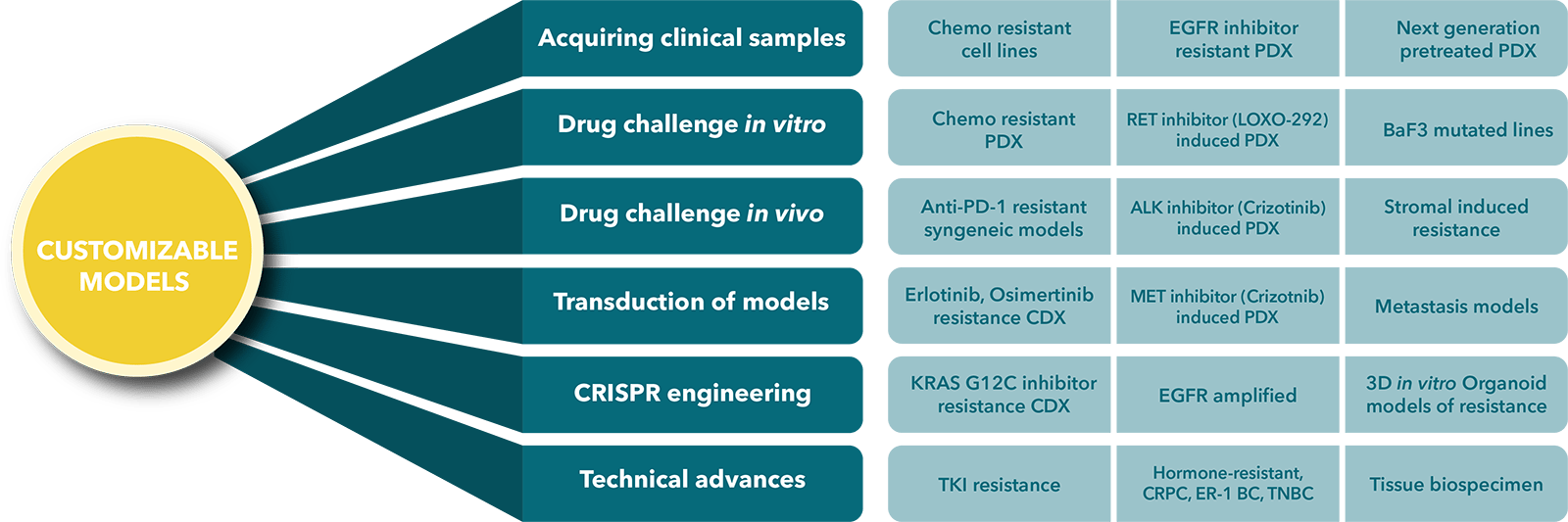
Our customized integrated solutions provide you with a comprehensive suite of resistance models across in vitro, in vivo, ex vivo, and in silico platforms, supported by a living biobank of over 30 cancer types. Our ongoing R&D efforts continually expand our catalog, and we offer custom model development to meet specific research needs. By integrating biomarker strategies, we help predict clinical responses while enabling the identification of translatable solutions and accelerating research progress.
Acquired Resistance
In Vitro
Generate and characterize resistant lines or organoids under drug pressure. Combine with functional screens and omics to identify resistance drivers.
- Generate resistant sublines via stepwise dose escalation or pulse exposure.
- Use 2D, 3D, or organoid systems.
- Combine with CRISPR screens, transcriptomics, or proteomics to identify resistance drivers.
- Enables functional validation and screening of second-line agents.
Acquired Resistance
In Vivo
Use patient-derived xenografts with drug exposure to model acquired resistance in tumor context, recapitulating stroma and microenvironment influence.
- Expose PDX models to therapy until escape or relapse occurs.
- Compare pre- and post-treatment tumors to discover adaptive changes.
- Facilitate evaluation of salvage therapies or combination strategies.
- PDX models maintain heterogeneity and microenvironment.
Mechanisms and Biomarker Services
Multiomic analysis, single-cell, longitudinal sampling, and pathway deconvolution help define resistance mechanisms and biomarkers predictive of escape.
- Apply bulk and single-cell RNA-seq, proteomics, phosphoproteomics, and metabolomics to reveal resistance pathways.
- Validate candidate biomarkers via IHC, flow cytometry, spatial transcriptomics in paired tumor samples.
- Longitudinal sampling (pre-treatment, on-treatment, post-relapse) enables mapping of clonal evolution.
- Integrate with functional assays to design next-line treatment hypotheses.
Frequently Asked Questions
Intrinsic resistance refers to tumor insensitivity present before treatment, while acquired resistance develops after exposure to therapy under selective pressure.
Typically months of dose escalation or pulse cycles, depending on drug, cell line, and selection stringency.
Yes, we have experience modeling resistance to small molecules, ADCs, PARP inhibitors, and immunotherapy through adapted dosing and combination pressure.
Candidate biomarkers from omics are validated by orthogonal assays (IHC, flow cytometry, functional perturbation) and by prospective testing in new models or patient samples.
Cancer Drug Resistance Resources
Unravel Resistance in Your Cancer Program
Reach out to our team to discuss resistance model design, biomarker strategy, or custom study proposals.
Mechanism of Action
- Targeted Protein Degradation (TPD)
- Unlike conventional small
- This fundamental difference moves pharmacology
- TPD harnesses this natural process to selectively eliminate specific proteins implicated in various diseases.
